Skip to content
 Looking for rodent control in St. Charles, MO, this March to protect your home from rats and mice as they become more active this Spring?
As a family-owned business, we have deep roots in the St. Charles community and understand the specific rodent issues local homeowners encounter.
Our neighbors have consistently trusted us to handle their rodent problems with professionalism and care.
With the arrival of spring, mice and rats become more active, searching for ways into your home after the winter.
We focus on comprehensive solutions that include identifying and sealing entry points to provide long-term relief from rodent intrusions.






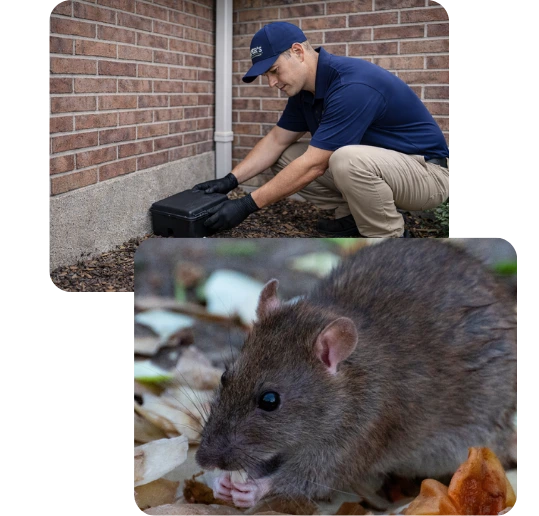
As St. Charles transitions into spring this March, mice and rats often become active and may attempt to breach your home’s exterior.
Our local pest experts start with a detailed inspection to locate specific entryways, for example, unsealed gaps near foundation vents or rooflines.
We then implement effective rodent control measures using traps and bait stations to address the current population.
Finally, we focus on prevention by performing exclusion services, which involves sealing those identified openings to stop future activity.
Rely on our team for comprehensive pest management that keeps your property secure.
Meet Our Rodent Control Team in St. Charles

Owner

Owner

Commercial Sales Manager

Field Operations Manager
Rodent control in St. Charles, Missouri
Choose the level of coverage that matches your pest pressure and service needs.
/mo
/mo
/mo
Tell us what pest you’re dealing with, and we’ll take it from there
By submitting, you agree to receive text messages from Holper’s Pest & Animal Solutions Pest & Animal Solutions at the number provided, including those related to your inquiry, follow-ups, and review requests, via automated technology. Consent is not a condition of purchase. Msg & data rates may apply. Msg frequency may vary. Reply STOP to cancel or HELP for assistance. Acceptable Use Policy
Call for immediate assistance and service.
Have questions? You’re not alone. Here are some helpful answers.
In St. Charles, rodent activity often increases during the spring, which can affect the service required for your home.
For customers on our recurring pest programs, we offer a rodent control add-on that starts with an initial fee of $180 for bait station installation, plus an $18 monthly service fee.
The overall cost is determined by factors such as the size of your property and the extent of the infestation, which helps us create the most effective plan for you.
As rodent activity increases this March in St. Charles, we focus on providing effective solutions rather than a monetary promise.
Our commitment is to resolve your rodent issue, which is why we provide re-service if activity continues after our initial treatment.
For example, if rodents reappear, our re-service may involve adjusting traps and sealing newly discovered entry points to ensure long-term control.
With rodent activity increasing during the spring here in St. Charles, we understand the need for prompt service.
We prioritize scheduling your appointment as quickly as our schedule allows to address the issue.
Our process involves a thorough inspection to identify entry points and determine the best course of action for your home.
Please call us directly to find the earliest available service date.
As March brings warmer weather to St. Charles, we focus on identifying exactly how rodents are utilizing your home for shelter.
Our pricing is determined by an on-site evaluation of the structure rather than a standard estimate.
For example, we assess the number of entry points and the specific exclusion materials required to properly seal your home against future intrusion.
As the weather warms up in March, we understand your concern for keeping your household secure while addressing rodent activity.
We utilize treatment methods designed with the well-being of your children and pets in mind.
For example, our rodent bait stations are secured and tamper-resistant to prevent access by non-target animals or curious hands.
We also prioritize exclusion work to seal entry points, reducing the need for interior measures.